
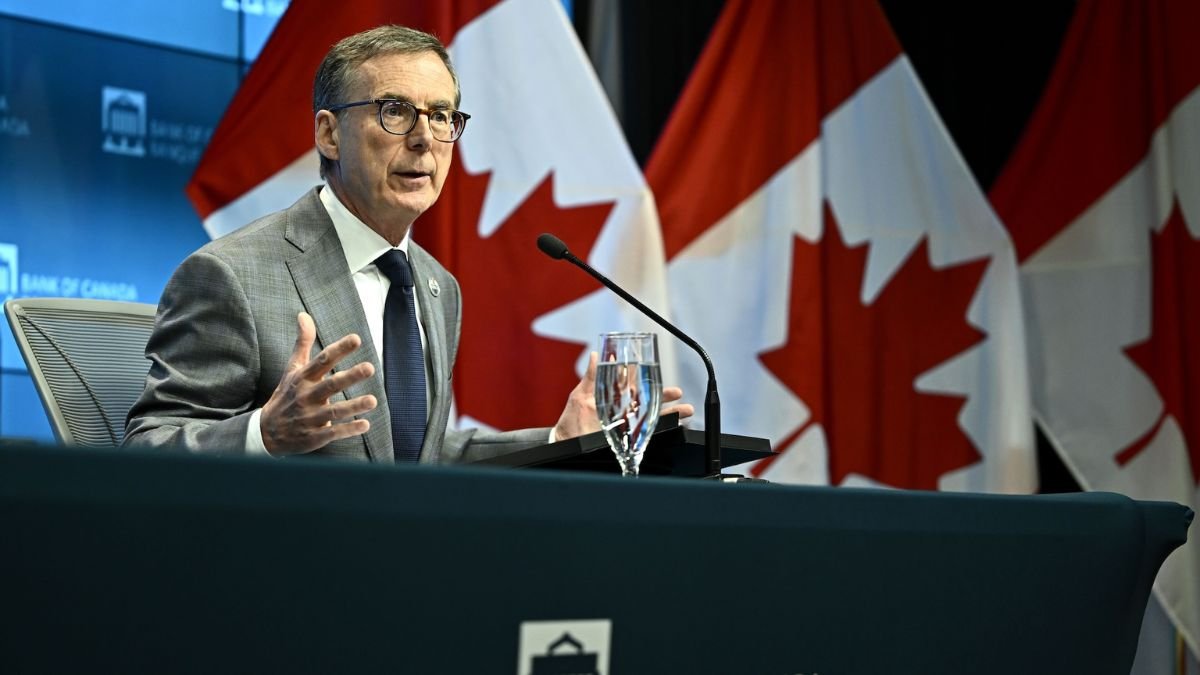
The Bank of Canada has indicated it will depend more heavily on internal judgment when making interest rate decisions, as global economic uncertainty continues to rise. According to recently released meeting minutes, policymakers acknowledged that traditional indicators alone may not be sufficient in the current environment.
The governing council emphasized the need for a more flexible and risk-based approach to monetary policy, particularly given ongoing geopolitical developments and evolving economic conditions.
Interest Rates Held Steady

The central bank decided to maintain its benchmark interest rate at 2.25% during its March 18 meeting. Governor Tiff Macklem stated that while the immediate inflationary effects of the Iran conflict would be monitored, the bank would act if inflation pressures became persistent.
The rate has remained at the lower end of the neutral range since October, meaning it is neither stimulating nor restricting economic growth.
Impact of Global Tensions on Inflation
The conflict involving Iran has led to a sharp rise in global oil prices, raising concerns about potential inflation spikes. However, policymakers noted that it is still too early to determine the long-term economic consequences of the situation.

The council acknowledged that higher energy costs could push inflation upward in the short term, but the broader impact remains uncertain.
Monitoring Key Economic Indicators
Bank officials stressed the importance of keeping all policy options open while closely tracking key developments. These include geopolitical tensions in the Middle East, U.S. trade policies, and incoming economic data.
Inflation has remained relatively stable, hovering near the midpoint of the bank’s target range of 1% to 3% for nearly a year. This stability provides the central bank with some flexibility in adjusting its policy stance.
Economic Growth and Labor Market Concerns

Recent data suggests that Canada’s economic growth and job market have weakened in recent months. Trade uncertainty and the upcoming review of the United States-Mexico-Canada Agreement have added further pressure to the economy.
Despite these challenges, the central bank is taking a cautious approach, allowing time to assess how global events unfold before making significant policy changes.
Market Expectations and Future Outlook
Financial markets are currently pricing in the possibility of two interest rate increases later in the year. This expectation is partly based on signals that geopolitical tensions could ease in the near term.
However, the Bank of Canada remains focused on managing risks and ensuring that any policy adjustments are aligned with evolving economic conditions.
Conclusion
The Bank of Canada’s decision to rely more on judgment highlights the complexity of today’s economic landscape. With global uncertainty, rising energy prices, and mixed domestic indicators, policymakers are adopting a cautious and flexible approach.
By keeping options open and closely monitoring developments, the central bank aims to maintain economic stability while preparing to respond to emerging risks. The path forward will depend on how geopolitical events and inflation trends evolve in the coming months.
